Etoolab Click Torque Wrenches for Precise Fastening
Etoolab's torque wrench line covers three drive sizes — 1/4-inch, 3/8-inch, and 1/2-inch — spanning from fine bicycle fasteners all the way to automotive lug nuts and suspension bolts. Each wrench uses a dual-direction adjustable 72-tooth ratchet head and ships with Metric and SAE markings, built for home mechanics and serious riders who need documented accuracy without a professional shop price tag.
Links to Amazon on this page are affiliate links — as an Amazon Associate, etoolab.net earns from qualifying purchases at no extra cost to you.

Both Models Side by Side
TW50FT 3/8" Torque Wrench
See on Amazon
TW230IP 1/4" Torque Wrench
See on AmazonSee more products
Discover the full product lineup with current selection on Amazon.
All products on AmazonSpecs Compared
Both wrenches share the same 72-tooth dual-direction head design and Metric/SAE dual-scale markings. The differences are drive size, torque range, and the fastener territory each one covers.
| Model | Drive Size | Torque Range | Length | Material | Best For |
|---|---|---|---|---|---|
| etoolab 1/4-Inch Drive Click Torque Wrench (TW230IP) | 1/4 inch | 10–230 in-lb / 1–25.9 Nm | — | — | Bicycles, MTB, e-bikes, small precision fasteners, carbon components |
| etoolab 3/8-Inch Drive Click Torque Wrench | 3/8 inch | 5–50 ft-lb / 5–69.4 Nm | 11.8 inches | Chromium molybdenum steel, powder coated | Motorcycles, automotive brake and underhood bolts, heavier bike hardware |
If your work centers on bicycles or e-bikes with specs under 25 Nm, start with the 1/4-inch. If you're maintaining a motorcycle or handling automotive fasteners in the 15–50 ft-lb range, the 3/8-inch is the right fit — and many home mechanics eventually own both.
How to Pick the Right Drive Size for Your Job
Drive size is the single most important decision when buying a torque wrench. It determines which sockets fit, and more critically, which torque range the wrench covers reliably. Etoolab offers two sizes in this line — 1/4-inch and 3/8-inch — each calibrated for a different set of tasks.
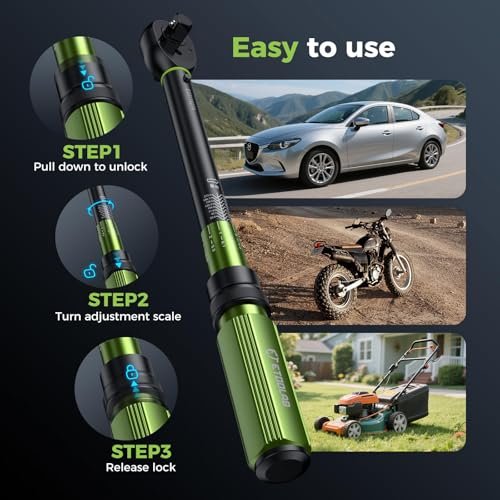
The 1/4-inch drive (10–230 in-lb / 1–25.9 Nm) is built for small, precise fasteners. That range covers stem bolts, brake caliper bolts, derailleur screws, handlebar clamps, and most MTB and e-bike assembly specs. Carbon fiber components in particular require low, exact torque values where over-tightening causes real damage — this is the wrench that handles that kind of work safely.
The 3/8-inch drive (5–50 ft-lb / 5–69.4 Nm) steps up to motorcycle fasteners, smaller automotive bolts, and general bike maintenance where the numbers run higher. Axle nuts, wheel bearing caps, and motorcycle engine covers commonly spec between 15 and 40 ft-lb — right in the middle of this wrench's reliable range. Keep in mind the standard 20% rule: for consistent accuracy, stay above 20% of the full-scale maximum. On the 3/8-inch wrench, that means readings below 10 ft-lb are less reliable — use the 1/4-inch drive for anything in that territory.
- Bicycles and MTB: 1/4-inch drive handles virtually every fastener on a modern bike, including carbon-safe torque specs under 10 Nm
- E-bikes and motor-assisted bikes: 1/4-inch for component bolts; 3/8-inch if you're torquing axle or motor mount hardware above 20 ft-lb
- Motorcycles: 3/8-inch covers most engine and chassis fasteners; consult your service manual — specs above 50 ft-lb (head bolts, swingarm pivots) need a 1/2-inch drive wrench
- Automotive: The 3/8-inch wrench handles brake caliper bolts (typically 25–44 ft-lb) and smaller underhood fasteners; lug nuts and suspension bolts typically require a 1/2-inch drive
What the 72-Tooth Ratchet Head Actually Changes
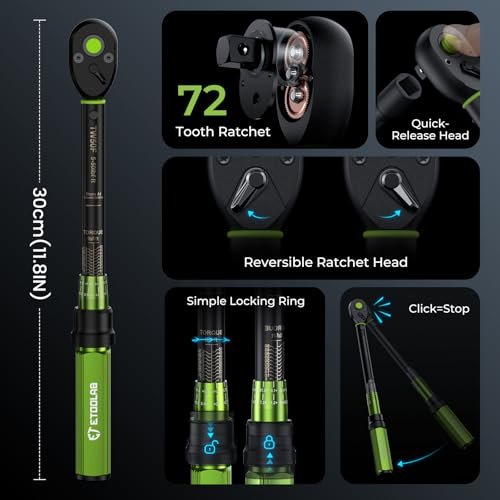
Both Etoolab wrenches use a 72-tooth ratchet mechanism. The tooth count determines the swing arc needed to advance the ratchet — specifically, 360 ÷ 72 = a 5-degree arc per tooth engagement. In practice, this means you only need 5 degrees of wrench movement to catch the next tooth and continue tightening. That's a meaningful advantage when you're working in confined spaces.
On a motorcycle engine cover with closely spaced bolts and limited swing room, a 72-tooth head lets you work in short, controlled strokes where a lower tooth-count wrench (common on budget tools at 24 or 36 teeth) would require you to reposition constantly or can't advance at all. The same applies to bicycle component work near a frame tube or within a wheel-and-fork assembly where the wrench arc is physically limited by the surrounding structure.
The dual-direction function — tighten clockwise, loosen counterclockwise — is controlled by the adjustment collar at the handle base. Both directions are calibrated, so you can use the same wrench to remove and re-torque a fastener without switching tools. Set the torque value before each use by rotating the handle until the scale reads your target spec; do not use the wrench as a breaker bar in the loosening direction without setting it first.
Storing, Zeroing, and Getting Accurate Reads Every Time
Torque wrench accuracy depends as much on how the tool is stored and used as on its internal mechanism. The most common mistake home mechanics make is leaving the wrench set at a working torque value between uses. The internal spring that drives the click mechanism stays compressed at higher settings, which causes it to take a set over time and drift the calibration. When you're done, dial the handle back to the minimum scale setting — on the 3/8-inch wrench, that's 5 ft-lb — before putting it away.
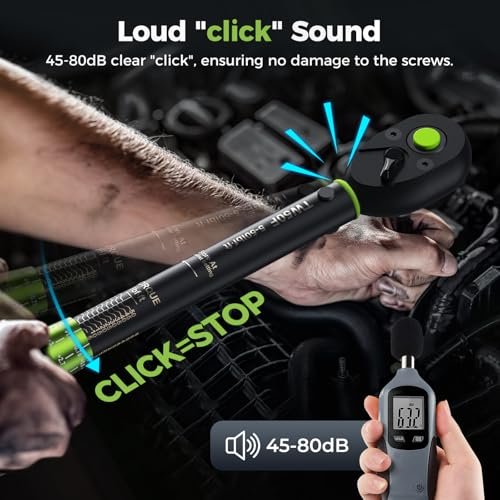
Before torquing a critical fastener, apply torque in smooth, steady pulls rather than jerking the handle. The click releases when the spring-loaded internal mechanism reaches the preset threshold — 45 dB minimum on Etoolab wrenches, audible over typical garage noise. Stop the moment you hear or feel the click. Continuing to turn after the click adds torque beyond your set value and defeats the purpose of the tool. If you're unsure whether you felt the click, back the fastener off slightly and re-torque from below the target value.
- Storage: Always return to minimum scale setting. Store horizontally or in the provided case — avoid hanging by the handle long-term, which stresses the adjustment mechanism
- Accuracy checks: If accuracy seems off after extended use, have the wrench calibrated at a tool calibration service — the Etoolab wrenches ship with a traceable serial certificate establishing the baseline
- Socket fit: Use only sockets that seat fully on the drive square. A loose or cracked socket introduces angular play that affects torque delivery at the fastener
- Lubrication: Torque fasteners dry unless the spec sheet explicitly calls for lubricated threads. Lubed threads require a lower torque value (typically 75–80% of the dry spec) — applying the same torque as dry will over-clamp the joint
- Chromium molybdenum steel: The CrMo construction is corrosion-resistant but not rust-proof. Wipe the head and body dry after use in humid environments and store away from standing moisture
Frequently Asked Questions
Do these wrenches come with a calibration certificate?
Yes. Etoolab click torque wrenches ship with a traceable serial calibration certificate confirming the ±3% accuracy standard. That's a document tied to the specific unit, not a general spec claim — relevant if you're working on anything where a service record matters, like suspension reassembly or brake hardware.
Can I use the 3/8-inch wrench on bicycle work?
For some bicycle fasteners, yes — axle nuts and some bottom bracket lockrings spec in the 30–40 ft-lb range where the 3/8-inch wrench is accurate and comfortable. For stem bolts, brake levers, derailleur clamps, and any carbon component with specs under 10 Nm (roughly 88 in-lb), the 1/4-inch drive is the correct tool. Applying a 3/8-inch wrench to small fasteners at the low end of its scale introduces accuracy risk and increases the chance of over-tightening.
What does "dual-direction" mean on these wrenches?
Both Etoolab wrenches can deliver calibrated torque in either the clockwise (tightening) or counterclockwise (loosening) direction. You set the direction using the adjustment collar. This is useful for left-hand threaded fasteners — some bicycle pedals and older engine components use reverse threads — and for applications where you need to re-torque after a loosening check without switching tools.
How loud is the click, and will I actually hear it during a repair?
Etoolab wrenches are tested to produce a minimum 45 dB click — audible in a typical garage environment. If you're working near running equipment or in a noisy shop, you'll also feel the mechanical release through the handle. The click is a definitive snap, not a subtle vibration. Most users report hearing it clearly even when partially under a vehicle or focused on an awkward reach.
Is the 3/8-inch wrench enough for automotive lug nuts?
For most passenger vehicles, no — lug nut torque specs commonly run 80–120 ft-lb, which exceeds the 3/8-inch wrench's 50 ft-lb maximum. The 3/8-inch wrench handles brake caliper bolts, rotor screws, and underhood fasteners that fall within its range. For lug nuts and suspension components, a 1/2-inch drive wrench rated to at least 150 ft-lb is the right tool.