Etoolab Cordless Work Lights for Mechanics
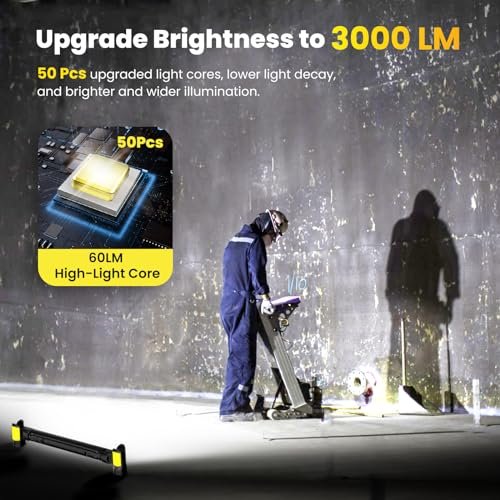
Both lights in this line run on a 5,200mAh rechargeable battery, hit 3,000 lumens from a 50-chip COB panel, and mount magnetically so your hands stay on the job. One adds auto-on motion sensing; the other adds three-way color temperature control and USB-C fast charging. Either way, no cord, no cord management, no excuses for squinting at a fastener.
Links to Amazon on this page are affiliate links — as an Amazon Associate, etoolab.net earns from qualifying purchases at no extra cost to you.

Both Models, Side by Side
L3 Work Light — Motion Sensor
See on Amazon
L3 Lite Work Light — 3-Color
See on AmazonSee more products
Discover the full product lineup with current selection on Amazon.
All products on AmazonSpecs Compared
Both lights share the same battery capacity and lumen output — the differences are in how they mount, how they control light quality, and how they turn on. Here's the full side-by-side.
| Model | Light Output | Battery | Special Features | Dimensions | Weight | Best For |
|---|---|---|---|---|---|---|
| Auto-On Work Light (B0CFL6D68V) | 3,000 lumens max · 50-chip COB | 5,200mAh lithium polymer · included | Infrared motion sensor auto-on/off · magnetic mount · hook included | 19.6 × 1.4 × 1.4 in | 1.28 lbs | Solo mechanics who need hands-free activation during under-hood repairs |
| 3-Mode Color Temp Work Light (B0F6V96VNH) | 3,000 lumens max · 50-chip COB | 5,200mAh · USB-C fast charge · included | 3 color temperature modes · 360° rotatable head · 180° swivel magnetic base · hook included | 18.9 × 2.0 × 2.0 in | 1.19 lbs | Detail-oriented work where color accuracy matters — wiring, fluid checks, paint matching |
If neither special feature — motion sensing vs. color temperature control — is a priority for your work, the auto-on model's longer profile gives it a slight edge for wide engine bays; the three-mode model's lighter weight and USB-C charging make it the easier tool to keep ready day-to-day.
How to Choose Between the Two Work Lights
The core hardware is nearly identical across both lights: 3,000-lumen maximum output, 50-chip COB LED panel, 5,200mAh battery, magnetic base, and a hook for overhead hanging. The decision comes down to two questions — do you want the light to turn itself on, and do you care about color temperature?
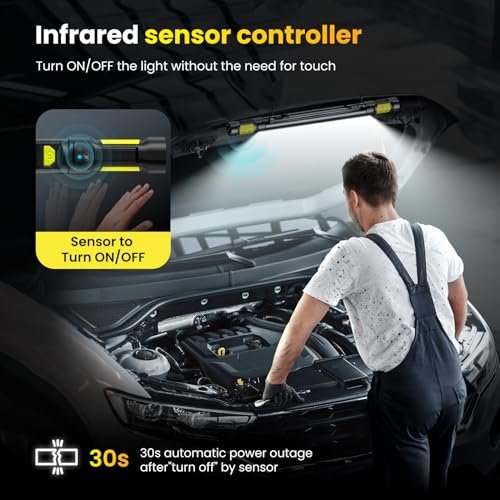
If you work alone under a hood and your hands are usually occupied when you lean into the engine bay, the auto-on model (B0CFL6D68V) is the practical pick. Its infrared motion sensor detects movement and kicks the light on without you touching anything. It's a narrow but genuine advantage when you're holding a socket extension with both hands. This model is also slightly longer at 19.6 inches, which can help span wider engine bays.
If auto-on doesn't matter to you but color accuracy does, the three-mode model (B0F6V96VNH) is the better choice. Three color temperature settings let you shift between warm, neutral, and daylight-equivalent light — useful when you're reading wire color codes, checking fluid colors, or matching paint. It also adds a 360° rotatable lamp head and a 180° swivel magnetic base, giving you more precise aim. USB-C fast charging means less downtime between jobs. It's slightly lighter at just under 1.2 lbs versus 1.28 lbs for the auto-on version.
- Want hands-free activation: Auto-on motion sensor model (B0CFL6D68V)
- Need color accuracy or adjustable warmth: Three-mode color temp model (B0F6V96VNH)
- Working alone in tight engine bays: Either — both mount magnetically and hang from a hook
- Charging convenience matters: Three-mode model charges via USB-C; confirm your charger before buying the other
Real Setups Where These Lights Actually Earn Their Keep
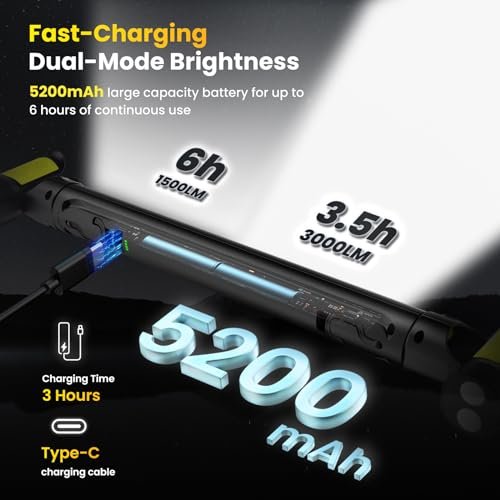
The magnetic base is the feature that changes how you actually work. On most modern vehicles, the underside of the hood, the firewall, and the strut towers are all steel — the light sticks directly to any of those surfaces and holds position while you work. No clamp to adjust, no assistant holding a flashlight at the wrong angle. The 5,200mAh battery is enough for a long session: expect roughly 3.5 hours at full brightness and closer to 6 hours on a lower setting, which is more than enough for an oil change, brake job, or alternator swap in a single sitting.
The hook mount handles non-steel surfaces — plastic engine covers, fiberglass hoods, or any situation where you want the light hanging overhead rather than side-mounted. Both models include the hook. At under 1.3 lbs with the battery installed, either light hangs without putting stress on a standard S-hook or tool cart rail.
Beyond automotive work, both lights are well-suited for job site use in crawl spaces, attics, and utility areas where running an extension cord is inconvenient or impractical. The cordless format also means both are usable outdoors — checking on a generator, working in a detached garage, or doing a late-season repair in the dark when you'd rather not string power to the driveway. The three-mode model's 180° swivel base is particularly useful for ground-level work, where you need to angle the light up at a vertical surface rather than down at a horizontal one.
Charging, Storage, and Getting the Most Runtime
Both lights run on a built-in 5,200mAh lithium polymer battery — there's no swapping cells or buying spares. That's a simpler setup but it means charging discipline matters. The three-mode model supports USB-C fast charging, which meaningfully cuts recharge time compared to older Micro-USB connections. For the auto-on model, check what cable the charger uses and keep it with the light so it's always ready. Storing either light with a partial charge rather than fully depleted extends long-term battery health — don't finish a repair session and leave it at 0% for a week.
The COB LED panel has no replaceable bulb — it's sealed into the housing. That's typical for this type of light and not a concern under normal use; COB LEDs are rated for tens of thousands of hours. What shortens the life of a work light faster than the LEDs is physical damage: drops onto concrete, impact on the panel, or water intrusion. Both lights use ABS housing, which handles impact better than the cheap polycarbonate shells on lower-grade lights, but neither is rated for submersion. Keep them out of standing water and wipe down the lens if it picks up oil or grease — a dirty panel can reduce effective output noticeably.
- Charge before storing, not after: Leaving either light at full depletion repeatedly shortens battery lifespan
- Clean the lens regularly: Oil film on the COB panel reduces perceived brightness — a quick wipe with a microfiber cloth takes 10 seconds
- Use low mode for ambient lighting: If you're just illuminating a garage workspace rather than doing precision repair, low mode nearly doubles your runtime
- Store horizontally or hung: Both lights are slim enough to hang on a hook or lie flat in a drawer without taking up meaningful space
Frequently Asked Questions
How long does the battery last on a full charge?
At maximum 3,000-lumen output, expect roughly 3.5 hours of runtime from the 5,200mAh battery. On a lower brightness setting, that extends to approximately 6 hours — enough for a long garage session without stopping to recharge. Both models use the same battery capacity, so runtime is comparable across the line.
Does the motion sensor stay on the whole time, or does it shut off when you step away?
The auto-on model's infrared sensor activates the light when it detects movement and turns it off after a period of inactivity — useful for under-hood work where you're leaning in and out. If you need it to stay on continuously while you step away from the vehicle, the light also has a manual mode that keeps it on regardless of motion. Both modes are accessible on the same unit.
Will the magnet hold on a painted hood or trunk lid?
The magnetic base requires bare or thin-coated steel to hold properly. Standard automotive paint is thin enough that the magnet grips most steel hoods, fenders, and firewall surfaces without issue. It won't hold on aluminum hoods — common on some newer trucks and European vehicles — or on plastic engine covers. In those situations, use the included hook for overhead hanging instead.
What's the point of three color temperature modes on a work light?
Color temperature affects how well you can distinguish between similar colors under the light. At a warm setting, red and orange wires look more similar than they do under daylight-equivalent (6500K) light. For reading wire harness colors, checking whether brake fluid has gone dark, or inspecting a paint match, the cooler daylight mode shows more accurate color than a single-temperature light can. If you're doing purely mechanical work — torquing bolts, pulling sensors, replacing pads — a single brightness mode is fine. If you do any electrical or detail work, the three-mode model earns its keep.
Can these be used outdoors, or are they only for garage use?
Both lights are cordless and battery-powered, so there's no cord exposure concern. The ABS housing handles typical outdoor conditions — incidental rain, dust, temperature variation. Neither light is rated for submersion or sustained exposure to water, so they're not suitable for use in heavy rain or wet crawl spaces with standing water. For dry outdoor work — driveway repairs, generator checks, detached garage use — both perform the same as they would inside.
Is 3,000 lumens actually enough to light an engine bay?
3,000 lumens from a COB panel at close range is more than sufficient for under-hood work. A typical professional automotive service bay runs between 500 and 1,500 lumens at the work surface — you're positioning these lights 12 to 18 inches from what you're working on, so effective illumination at the surface is high. The COB panel spreads light more evenly than a spotlight-style LED, which eliminates the harsh shadow lines that make it hard to see into corners and behind components. For reference, a standard shop drop light runs 800–1,200 lumens; 3,000 at close range is a meaningful step up.